
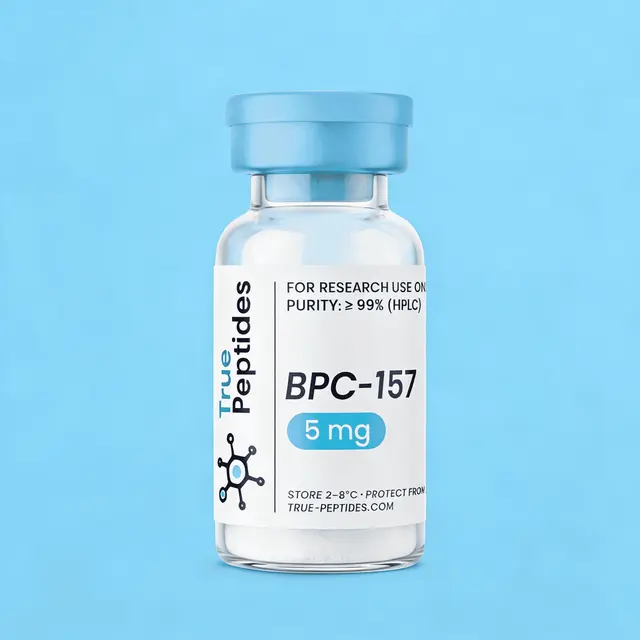
BPC-157
Price range: $44.00 through $59.00
BPC-157 is an intriguing experimental peptide with a substantial body of preclinical research. Studies have investigated its potential relationship with tissue repair, tendon and muscle biology, gastrointestinal processes, angiogenesis, inflammation, and other biological pathways.
BPC-157: A Complete Guide to Research, Potential Benefits and Safety
BPC-157 is an experimental peptide that has attracted considerable interest in regenerative medicine, sports science, gastrointestinal research, and peptide research. Also known as Body Protection Compound-157, BPC-157 is a synthetic 15-amino-acid peptide that has been investigated primarily in laboratory and animal models.
Interest in BPC-157 has increased substantially in recent years, particularly among researchers studying tissue repair, inflammation, gastrointestinal biology, muscles, tendons, and other aspects of regenerative science. However, it is important to distinguish promising laboratory findings from established medical evidence. Current human research remains limited, and BPC-157 is not an approved general medical treatment.
What Is BPC-157?
BPC-157 is a synthetic pentadecapeptide consisting of 15 amino acids. It was originally described as being derived from a gastric protein fragment and has subsequently become the subject of extensive preclinical investigation.
Researchers have studied BPC-157 in connection with several biological processes, including tissue repair, angiogenesis, inflammation, gastrointestinal function, and musculoskeletal recovery. Much of the published evidence comes from animal experiments or laboratory models rather than large, randomized human clinical trials.
A 2026 review described BPC-157 as having substantial preclinical research behind it while emphasizing that pharmaceutical development remains incomplete, including the absence of an approved formulation and validated dosing regimen.
How Does BPC-157 Work?
The precise mechanism of BPC-157 is not fully established.
Preclinical research has investigated interactions involving pathways associated with nitric oxide signaling, angiogenesis, growth-factor activity, inflammatory responses, and tissue remodeling. Researchers have proposed that these mechanisms may contribute to the biological effects observed in laboratory and animal studies.
However, mechanisms observed in experimental models should not automatically be interpreted as proven therapeutic effects in humans.
Understanding exactly how BPC-157 behaves in the human body remains an important area for future research.
BPC-157 and Tissue Repair Research
One of the major reasons BPC-157 has attracted scientific attention is research involving tissue repair.
Animal studies have investigated BPC-157 in models involving muscles, tendons, ligaments, bones, and other tissues. A 2025 systematic review identified numerous preclinical studies reporting potentially favorable outcomes in musculoskeletal injury models, while also noting that human clinical evidence was extremely limited.
These findings provide a scientific basis for continued investigation but do not establish BPC-157 as an effective treatment for injuries.
Well-controlled human studies are necessary to determine whether results observed in animals translate into meaningful clinical benefits.
BPC-157 and Muscle Research
BPC-157 has also been studied in experimental models involving muscle injury and recovery.
Preclinical research has examined processes such as blood-vessel formation, cellular signaling, inflammatory responses, and tissue remodeling. These findings have contributed to growing interest in BPC-157 among researchers studying musculoskeletal biology.
Nevertheless, laboratory research should not be confused with evidence that BPC-157 improves athletic performance or accelerates recovery in humans.
There is currently insufficient clinical evidence to establish such claims.
BPC-157 and Tendon Research
Tendons are another important area of BPC-157 research.
Animal and laboratory studies have explored whether BPC-157 may influence tendon healing and the biological processes involved in connective-tissue repair. The results have generated scientific interest, particularly in sports medicine and orthopaedic research.
A systematic review published in the sports-medicine literature found that most available BPC-157 research was preclinical, with only very limited human evidence.
This means that BPC-157 should currently be regarded as an investigational research subject rather than an established tendon treatment.
BPC-157 and Gastrointestinal Research
BPC-157 has also been investigated in gastrointestinal research.
Animal studies have examined its effects in various models of gastrointestinal injury and inflammation. The peptide’s original association with gastric biology is one reason it continues to attract interest in this field.
The FDA reviewed BPC-157 in connection with proposed compounding uses and reported that available clinical safety information is insufficient to characterize its safety profile. The agency also noted that it found no studies administering BPC-157 to humans through several proposed routes, including oral, subcutaneous, nasal, and transdermal administration.
Consequently, claims about gastrointestinal treatment should be approached cautiously.
Is BPC-157 FDA Approved?
No. BPC-157 is not an FDA-approved medicine.
The FDA has identified significant uncertainties regarding BPC-157, including limited human safety information and potential concerns relating to immunogenicity and peptide impurities.
This is an important consideration for anyone researching BPC-157 products online.
The presence of BPC-157 on a website or marketplace does not mean that the product has undergone the approval process required for an authorized medicine.
Is BPC-157 Safe?
The safety profile of BPC-157 in humans has not been adequately established.
The FDA’s 2026 review identified only a small number of clinical studies and emphasized their limitations, including small sample sizes, short durations, exploratory dosing, and limited safety monitoring.
A recent scientific review similarly concluded that the available human evidence is too limited to establish a reliable clinical safety profile.
Therefore, it would be inappropriate to describe BPC-157 as proven safe for human use.
BPC-157 Research and Clinical Evidence
Current BPC-157 research consists largely of laboratory and animal studies.
A 2025 systematic review identified 36 relevant studies, of which 35 were preclinical and only one was a clinical study within the review’s inclusion criteria. The authors concluded that BPC-157 showed promise in preclinical musculoskeletal research but that clinical safety data remained inadequate.
The FDA’s subsequent review identified several small human studies but likewise concluded that the available evidence was insufficient to characterize safety adequately.
This difference between extensive preclinical research and limited clinical research is one of the most important facts to understand about BPC-157.
BPC-157 for Research Purposes
BPC-157 continues to attract interest as a subject of peptide and regenerative-medicine research.
Researchers evaluating experimental peptide materials should consider factors such as compound identity, analytical characterization, purity testing, batch information, storage conditions, manufacturing controls, and appropriate research-use documentation.
A stated purity percentage does not establish pharmaceutical approval, clinical safety, or therapeutic effectiveness.
Research materials should be handled according to appropriate laboratory procedures and applicable institutional and regulatory requirements.
BPC-157 and Sports
BPC-157 has received particular attention within sports and athletic communities because of claims surrounding injury recovery and performance.
However, researchers and athletes should be aware that BPC-157 is prohibited under the World Anti-Doping Agency’s prohibited list. The 2025 systematic review also noted its banned status in professional sport.
Athletes subject to drug-testing rules should therefore consult the current rules of their governing organization before using any substance.
The Future of BPC-157 Research
The future of BPC-157 depends largely on better-quality clinical research.
Future studies need appropriate pharmaceutical formulations, standardized dosing, controlled study designs, larger participant populations, reliable pharmacokinetic data, and long-term safety monitoring.
A 2026 review highlighted several of these development barriers, including limited pharmacokinetic characterization, formulation challenges, and the absence of a completed Phase II clinical program.
These areas will need to be addressed before BPC-157 can be evaluated with the same level of confidence expected for established medicines.
Conclusion
BPC-157 is an intriguing experimental peptide with a substantial body of preclinical research. Studies have investigated its potential relationship with tissue repair, tendon and muscle biology, gastrointestinal processes, angiogenesis, inflammation, and other biological pathways.
However, the current evidence should be interpreted carefully. Most research has been conducted in laboratory or animal models, while human clinical evidence remains limited. Recent FDA assessments have highlighted insufficient safety information and concerns relating to immunogenicity and peptide characterization.
For people searching for BPC-157, BPC-157 peptide, BPC-157 research, BPC-157 benefits, or BPC-157 safety, the most important distinction is between experimental findings and clinically established evidence.
| QUANTITY | 5mg, 10mg |
|---|
Be the first to review “BPC-157”
Related products
Peptide Catalog
Peptide Catalog
Peptide Catalog
Peptide Catalog
Peptide Catalog
Reviews
There are no reviews yet.