
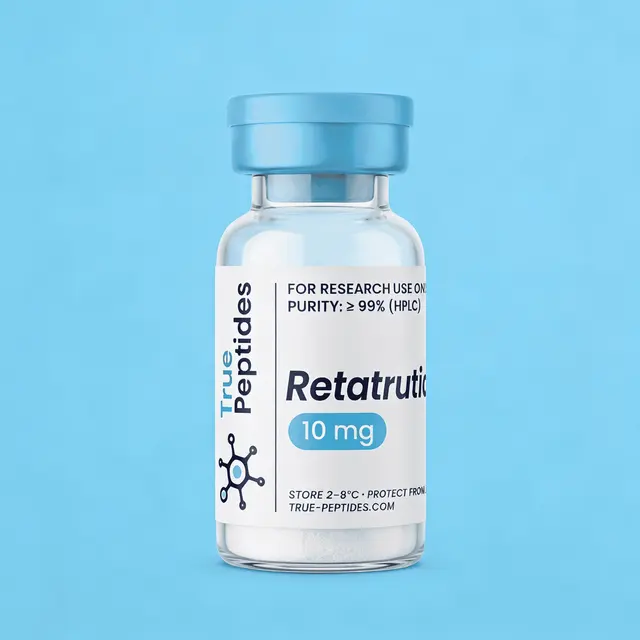
Retatrutide
Price range: $89.00 through $205.00
Retatrutide (LY3437943) is a novel long-acting peptide agonist targeting three incretin-related receptors: glucagon-like peptide-1 (GLP-1), glucose-dependent insulinotropic polypeptide (GIP), and glucagon receptors. Developed by Eli Lilly, it is the first triple agonist of its class to enter advanced clinical investigation.The molecule features a 39-amino-acid sequence with a C20 fatty diacid moiety enabling albumin binding and extended half-life.
Retatrutide: A Comprehensive Guide to the Investigational Triple Agonist
Retatrutide has become one of the most closely watched investigational compounds in modern metabolic research. Sometimes searched online as retatrutide peptide, retatrutide for sale, retatrutide research, or LY3437943, this investigational molecule has attracted significant scientific interest because of its unique activity across three hormone receptor pathways.
Developed by Eli Lilly and Company, retatrutide is being evaluated in Phase 3 clinical trials for obesity, type 2 diabetes, and several related conditions. Unlike single-receptor and dual-receptor medicines, retatrutide is designed to activate three receptors: GIP, GLP-1, and glucagon.
What Is Retatrutide?
Retatrutide, also known by its development code LY3437943, is an investigational once-weekly triple hormone receptor agonist. Its mechanism involves activation of the receptors for glucose-dependent insulinotropic polypeptide (GIP), glucagon-like peptide-1 (GLP-1), and glucagon.
This triple-receptor approach is what makes retatrutide particularly interesting to researchers studying metabolic biology. Rather than focusing on a single pathway, the molecule is being investigated for its combined effects across several interconnected hormonal systems.
The term “GLP-3” sometimes appears in online discussions about retatrutide. However, this is an informal term rather than an established scientific classification. “Triple agonist” is a more accurate description of its pharmacological profile.
How Does Retatrutide Work?
Retatrutide is designed to activate three hormone receptors simultaneously.
GIP and GLP-1 are involved in metabolic regulation, while the glucagon receptor is associated with energy metabolism and other physiological processes. Researchers are investigating whether combining these pathways can produce meaningful effects in people with obesity, type 2 diabetes, and other metabolic conditions.
The scientific interest surrounding retatrutide comes largely from this multi-receptor mechanism. However, its ultimate clinical role depends on the completion of clinical development and regulatory evaluation.
Retatrutide Clinical Research
Retatrutide has progressed beyond early-stage research and is currently being evaluated in Phase 3 clinical trials.
Lilly has reported Phase 3 results from several studies, including trials within the TRIUMPH and TRANSCEND development programs. Research has examined populations with obesity or overweight, type 2 diabetes, cardiovascular disease, knee osteoarthritis pain, obstructive sleep apnea, and other related conditions. Additional studies are investigating areas including metabolic dysfunction-associated steatotic liver disease and cardiovascular and renal outcomes.
In July 2026, Lilly announced positive topline results from TRIUMPH-2 and TRIUMPH-3. The company reported that participants receiving retatrutide in those studies experienced substantial improvements in body weight and, in TRIUMPH-2, glycated hemoglobin. Detailed results from those trials are being presented and published through scientific channels.
These findings are significant research developments, but they should not be confused with regulatory approval.
Retatrutide Availability in the USA, UK, and Europe
Interest in retatrutide for sale has grown considerably as clinical research has progressed. However, search availability and legal pharmaceutical availability are not the same thing.
Lilly states that retatrutide is not yet available for public use and is legally available only to participants in Lilly-sponsored clinical trials.
This distinction is important for consumers and researchers in the United States, United Kingdom, and Europe.
Regulatory requirements can vary between countries, and the appearance of a retatrutide product on an online marketplace does not establish that the product is approved, authentic, safe, or legally authorized for human use.
Anyone researching retatrutide should therefore verify information through appropriate regulatory agencies, clinical-trial registries, scientific publications, and other authoritative sources.
Retatrutide Compared With Other Peptide-Based Medicines
Retatrutide is often compared with well-known metabolic medicines such as semaglutide and tirzepatide.
Semaglutide is primarily a GLP-1 receptor agonist, while tirzepatide activates GIP and GLP-1 receptors. Retatrutide differs because it is being investigated as a GIP, GLP-1, and glucagon triple agonist.
These differences in receptor activity are an important reason researchers are studying retatrutide separately rather than treating it as simply another GLP-1 medicine.
What Researchers Should Know About Retatrutide
Researchers evaluating peptide materials should pay close attention to product identity, analytical documentation, purity information, batch records, storage requirements, and the intended-use classification of any material.
A stated purity percentage alone does not establish that a material is safe for human use or approved as a pharmaceutical.
Similarly, a website describing a product as “research use only” does not mean that the compound has been approved by a regulatory authority.
For legitimate laboratory research, appropriate documentation and responsible handling are essential.
Why Retatrutide Is Attracting Scientific Interest
The primary scientific interest in retatrutide comes from its triple-receptor mechanism.
By simultaneously targeting GIP, GLP-1, and glucagon receptors, researchers are investigating whether retatrutide can influence multiple aspects of metabolic regulation through one molecule.
The ongoing Phase 3 program provides an opportunity to evaluate this approach across different populations and conditions. Lilly’s current development pipeline includes studies involving obesity, knee osteoarthritis pain, obstructive sleep apnea, type 2 diabetes, cardiovascular and renal outcomes, and metabolic dysfunction-associated steatotic liver disease.
The Future of Retatrutide
The future availability of retatrutide will depend on continued clinical development and regulatory review.
Lilly has indicated that it plans to seek FDA review following its Phase 3 development program. Until regulatory authorities complete their evaluations, retatrutide should continue to be described as an investigational compound, rather than an approved medicine.
For researchers, healthcare professionals, and consumers following peptide science, future regulatory decisions and peer-reviewed clinical results will provide important information about the compound’s potential role.
Conclusion
Retatrutide represents an important development in peptide and metabolic research. As an investigational GIP, GLP-1, and glucagon triple receptor agonist, it has a distinct mechanism that separates it from single- and dual-receptor approaches.
| QUANTITY | 10 mg, 20 mg, 30 mg, 40 mg |
|---|
Be the first to review “Retatrutide”
Related products

Peptide Catalog
Reviews
There are no reviews yet.