
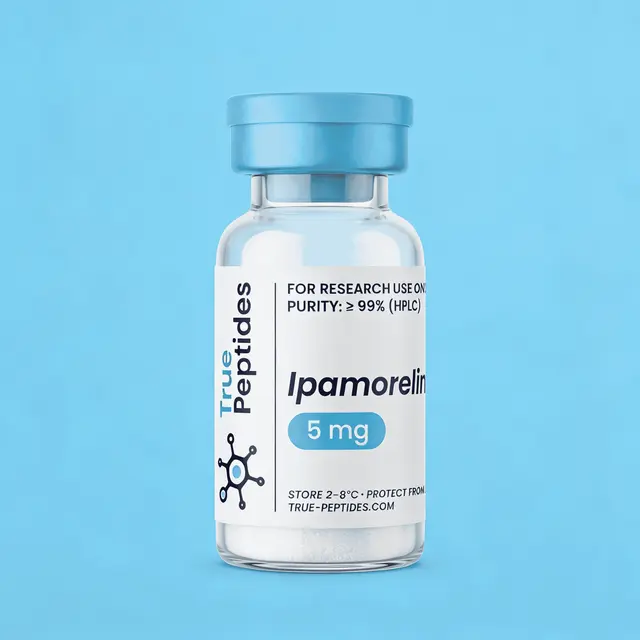
Ipamorelin
Price range: $45.00 through $65.00
Ipamorelin is a selective pentapeptide growth hormone secretagogue (GHS) with the sequence Aib-His-D-2-Nal-D-Phe-Lys-NH₂. Developed by Novo Nordisk, it is one of the most selective GHS receptor (GHSR/Ghrelin receptor) agonists available for research, demonstrating high specificity for GH release without significant effects on ACTH, cortisol, prolactin, or aldosterone secretion.Laboratory research has investigated Ipamorelin’s binding to the growth hormone secretagogue receptor type 1a (GHS-R1a), its effects on pulsatile GH release patterns, and its interaction with somatostatin signaling.
Ipamorelin: Product Description, Research Uses, Benefits and Safety
Ipamorelin is a synthetic peptide that has attracted interest in peptide research because of its activity at the growth hormone secretagogue receptor. It is commonly studied in connection with growth hormone (GH) signaling and endocrine research. Online, Ipamorelin is also frequently marketed for muscle growth, recovery, body composition, and anti-aging purposes, although these claims should not be confused with established clinical evidence.
This article provides a clear overview of Ipamorelin, its research characteristics, potential areas of investigation, and important considerations when evaluating an Ipamorelin product.
What Is Ipamorelin?
Ipamorelin is a synthetic pentapeptide that belongs to a class of compounds known as growth hormone secretagogues. Researchers have investigated its ability to stimulate growth hormone release by interacting with the growth hormone secretagogue receptor (GHS-R).
Unlike growth hormone itself, Ipamorelin is designed to influence the body’s own signaling pathways involved in growth hormone secretion. This mechanism has made the peptide relevant to experimental endocrinology and peptide pharmacology.
Ipamorelin is not the same as prescription human growth hormone (HGH), and research peptides should not automatically be considered substitutes for approved medicines.
How Does Ipamorelin Work?
Ipamorelin is studied for its interaction with the growth hormone secretagogue receptor, which is also involved in the physiological actions of ghrelin.
Activation of this receptor can influence the release of growth hormone from the pituitary gland. Research into selective growth hormone secretagogues has focused on understanding whether compounds can affect GH secretion while producing fewer effects on other hormonal pathways.
However, biological activity in experimental settings does not establish that Ipamorelin provides specific health, athletic, or anti-aging benefits in humans.
Ipamorelin Research and Potential Applications
Research involving Ipamorelin has primarily focused on growth hormone secretion and related endocrine pathways. Scientists have investigated growth hormone secretagogues in areas such as metabolism, tissue biology, and hormonal regulation.
Ipamorelin is also frequently discussed in research communities studying:
- Growth hormone signaling
- Endocrine physiology
- Peptide pharmacology
- Metabolic pathways
- Hormonal regulation
- Experimental recovery processes
These represent areas of scientific interest rather than approved medical indications.
Ipamorelin Benefits: What Does the Evidence Show?
Online marketing frequently associates Ipamorelin with muscle development, fat loss, improved recovery, better sleep, and anti-aging effects. However, evidence supporting these claims is limited and should be evaluated carefully.
The fact that Ipamorelin can influence growth hormone pathways does not demonstrate that using the peptide will produce predictable improvements in muscle mass, athletic performance, body composition, or general health.
High-quality human research is necessary to establish the effectiveness, appropriate applications, and long-term safety of any therapeutic use.
Ipamorelin vs. Other Growth Hormone Peptides
Ipamorelin differs from GHRH-related peptides such as CJC-1295 because it acts through the growth hormone secretagogue receptor rather than directly functioning as a GHRH analogue.
This difference is relevant in laboratory research because different peptide classes can influence the GH axis through different mechanisms. Combining peptides or using them for performance-related purposes can introduce additional uncertainties and should not be assumed to improve outcomes.
Product Quality and Purity
When evaluating an Ipamorelin research product, identity, purity, concentration, and manufacturing quality are important considerations.
Research peptides obtained through unverified sources may contain impurities, contaminants, incorrect concentrations, or substances other than those stated on the label. Appropriate analytical documentation can provide useful information about a product’s characteristics, although documentation does not make an experimental compound an approved medicine.
Proper storage and handling are also important considerations for peptide research materials.
Is Ipamorelin FDA Approved?
Ipamorelin is not an FDA-approved medication for muscle growth, weight loss, athletic recovery, anti-aging, or other commonly advertised purposes.
Products sold online as “research peptides” should not be represented as approved treatments. Regulatory requirements can also differ between countries, so researchers and consumers should consult the appropriate national regulatory authority regarding applicable rules.
Ipamorelin Safety Considerations
The long-term safety of Ipamorelin for human use has not been established to the standard required for an approved medicine. Because it influences growth hormone-related pathways, potential physiological effects and interactions require careful consideration.
Claims that Ipamorelin is completely safe or produces no side effects are not adequately supported by available evidence.
Individuals considering an experimental peptide for a health or performance-related purpose should consult a qualified healthcare professional before making decisions about its use.
Ipamorelin
Ipamorelin is a synthetic growth hormone secretagogue that has generated interest in endocrine and peptide research. Its interaction with growth hormone signaling makes it a subject of scientific investigation, while its potential effects on metabolism and other physiological processes continue to attract research interest.
Despite widespread online marketing, Ipamorelin should not be presented as a proven treatment for muscle growth, weight loss, recovery, or aging. Understanding the distinction between experimental research and established medical evidence is essential when evaluating any Ipamorelin product.
| QUANTITY | 5mg, 10mg |
|---|
Be the first to review “Ipamorelin”
Related products
Peptide Catalog
Reviews
There are no reviews yet.