
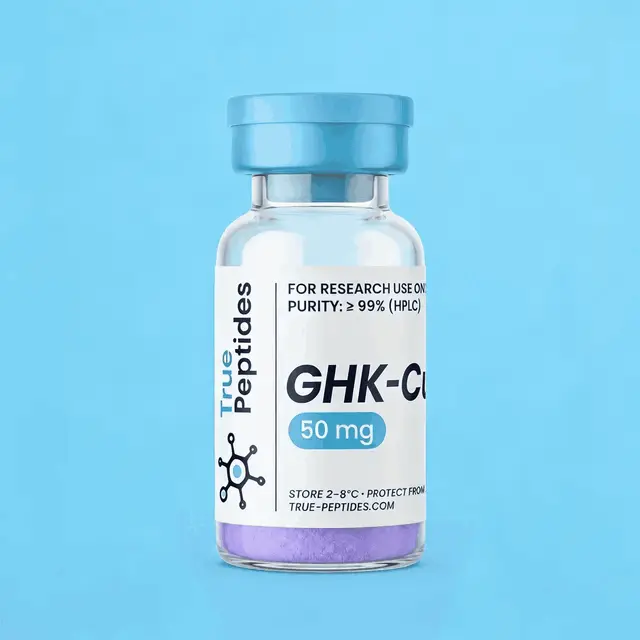
GHK-Cu
Price range: $40.00 through $60.00
GHK-Cu, also known as copper tripeptide-1, is a well-known copper-peptide complex that has attracted decades of scientific interest. Research has explored its relationship with skin remodeling, collagen-related processes, fibroblast activity, wound healing, and cosmetic applications.
GHK-Cu: A Complete Guide to Copper Peptide Research, Benefits and Uses
GHK-Cu, commonly known as copper peptide or copper tripeptide-1, has become a widely discussed ingredient in modern skincare, peptide research, and cosmetic science. Interest in GHK-Cu has grown across the USA, UK, Europe, and other international markets because of research into its relationship with skin remodeling, collagen production, wound healing, and tissue regeneration.
GHK-Cu is formed when the naturally occurring tripeptide glycyl-L-histidyl-L-lysine (GHK) binds with copper ions. Research has investigated GHK and GHK-Cu for decades, while more recent scientific work continues to examine their potential applications in skin health, regenerative biology, and cosmetic formulations.
What Is GHK-Cu?
GHK-Cu is a copper complex of the naturally occurring peptide GHK. The name GHK represents three amino acids: glycine, histidine, and lysine.
GHK has been detected naturally in human biological fluids, and researchers have proposed that its ability to bind copper may be relevant to biological processes involved in tissue repair and remodeling.
Because of these characteristics, GHK-Cu has attracted interest in both peptide research and cosmetic science.
It is important, however, to distinguish laboratory and cosmetic research from proven medical treatment. Although experimental and cosmetic studies have reported potentially interesting effects, the strength of evidence varies depending on the application, formulation, route of administration, and study design.
How Does GHK-Cu Work?
Researchers have investigated GHK-Cu in relation to several biological processes associated with tissue remodeling.
Laboratory research suggests that GHK-Cu may influence fibroblasts, extracellular-matrix components, collagen-related pathways, and cellular signaling involved in tissue repair. Earlier research also investigated its potential effects on inflammatory processes, angiogenesis, and wound healing.
This makes GHK-Cu particularly interesting in the fields of skin biology, regenerative research, and cosmetic formulation.
However, laboratory activity does not automatically translate into a clinically proven effect in humans. Researchers therefore continue to investigate how GHK-Cu behaves under different conditions and how effectively topical formulations deliver the peptide to the intended biological site.
GHK-Cu and Skin Research
One of the best-known areas of GHK-Cu research is skin science.
Studies have examined whether GHK-Cu can influence processes associated with collagen, elastin, extracellular-matrix remodeling, and skin appearance. Earlier research described potential effects on fibroblast activity and tissue remodeling, while cosmetic research has investigated its possible role in improving skin firmness, elasticity, and the appearance of fine lines.
A recent review of topical GHK and its derivatives concluded that GHK has promising biological properties, but also highlighted an important limitation: there is a surprising lack of high-quality clinical studies specifically evaluating GHK-Cu and related topical products for wrinkle reduction.
This distinction is important when evaluating online claims about copper peptides.
GHK-Cu and Collagen
Collagen is one of the primary structural proteins in skin and connective tissue.
Research into GHK-Cu has examined its relationship with collagen synthesis and extracellular-matrix remodeling. Experimental evidence suggests that GHK-related compounds can influence processes involving fibroblasts and matrix proteins.
These findings help explain why copper peptides are commonly included in skincare formulations designed around the appearance of aging skin.
Nevertheless, claims that a topical GHK-Cu product will produce a particular degree of collagen increase or wrinkle reduction should be interpreted cautiously unless supported by product-specific human clinical data.
GHK-Cu and Wound-Healing Research
GHK-Cu has also been investigated in the context of tissue repair and wound healing.
Experimental studies have examined copper-tripeptide complexes in wound models and cultured cells. Research has explored processes such as fibroblast activity, cellular migration, collagen-related activity, and tissue remodeling.
A recent scientific review published in 2026 also examined the regenerative potential of GHK-Cu and reported substantial preclinical interest while emphasizing the limited availability of standardized clinical guidelines.
These findings make GHK-Cu an interesting subject for continued research, but they should not be interpreted as evidence that GHK-Cu is an established treatment for wounds or medical conditions.
GHK-Cu in Cosmetics and Skincare
Copper peptides have become increasingly familiar in cosmetic formulations.
The Cosmetic Ingredient Review (CIR) has evaluated copper tripeptide-1 and related peptide ingredients as used in cosmetics. Its safety assessment concluded that the ingredients reviewed were safe under the present cosmetic practices and concentrations described in that assessment.
This is an important distinction: a cosmetic ingredient safety assessment evaluates an ingredient under specified cosmetic conditions. It does not establish that every GHK-Cu product, concentration, formulation, or route of administration is safe or medically effective.
Consumers should therefore evaluate the complete formulation and follow the manufacturer’s directions.
GHK-Cu, Copper Peptides and Anti-Aging Skincare
GHK-Cu is often associated with anti-aging skincare because researchers have investigated its potential relationship with collagen, skin elasticity, firmness, and extracellular-matrix remodeling.
Some studies have reported improvements in skin characteristics, while other controlled research has produced more limited findings. For example, a clinical study involving GHK-Cu products after CO₂ laser resurfacing found no significant differences in several objective outcomes, although one questionnaire-based measure of overall skin quality favored the GHK-Cu group.
This illustrates why product-specific evidence matters.
The presence of GHK-Cu in a skincare product does not guarantee a particular cosmetic outcome.
GHK-Cu Research in the USA, UK and Europe
Interest in GHK-Cu extends across the international cosmetic and research markets.
In the USA, copper tripeptide-1 is used as a cosmetic ingredient, and CIR has published safety assessments concerning its cosmetic use.
In the UK and Europe, cosmetic ingredients are subject to applicable national and European regulatory frameworks. Companies marketing cosmetic products must ensure that their products, ingredient declarations, safety assessments, claims, labeling, and distribution comply with the requirements applicable to their target markets.
Because regulations can change and differ depending on product classification and intended use, businesses and consumers should verify current requirements in their jurisdiction.
How to Evaluate a GHK-Cu Product
When evaluating a GHK-Cu product, consumers and researchers should look beyond the phrase “copper peptide.”
Important factors may include:
- The exact ingredient identity
- Concentration or formulation
- Product purity, where applicable
- Batch information
- Available analytical documentation
- Manufacturing standards
- Storage requirements
- Intended use
- Product-specific safety information
- Evidence supporting any advertised claims
For research materials, analytical documentation can be particularly important. For cosmetics, the complete formulation and applicable safety assessment are equally relevant.
The Future of GHK-Cu Research
GHK-Cu remains an interesting subject in peptide science because it sits at the intersection of biochemistry, skin research, cosmetic science, and regenerative biology.
Researchers continue to investigate how copper-peptide complexes interact with cells and extracellular-matrix processes and whether improved delivery systems can produce more predictable results.
Recent research has also explored new copper-tripeptide complexes and their potential effects in wound-healing models, demonstrating that copper-peptide chemistry remains an active area of scientific investigation.
Future human studies will be important for determining how strongly laboratory findings translate into measurable benefits in real-world cosmetic or clinical settings.
Conclusion
GHK-Cu, also known as copper tripeptide-1, is a well-known copper-peptide complex that has attracted decades of scientific interest. Research has explored its relationship with skin remodeling, collagen-related processes, fibroblast activity, wound healing, and cosmetic applications.
Its popularity in skincare is supported by substantial laboratory and cosmetic research, and CIR has assessed copper tripeptide-1 as safe under specified cosmetic conditions.
At the same time, consumers should be cautious about exaggerated claims. A 2025 review highlighted the limited number of clinical studies specifically evaluating topical GHK-Cu for wrinkle prevention and reduction.
For anyone researching GHK-Cu, copper peptides, GHK copper peptide, or GHK-Cu skincare in the USA, UK, Europe, or elsewhere, the most useful approach is to distinguish established cosmetic use from preliminary laboratory findings and clinical claims.
| QUANTITY | 50mg, 100mg |
|---|
Be the first to review “GHK-Cu”
Related products
Peptide Catalog
Peptide Catalog
Peptide Catalog
Reviews
There are no reviews yet.