
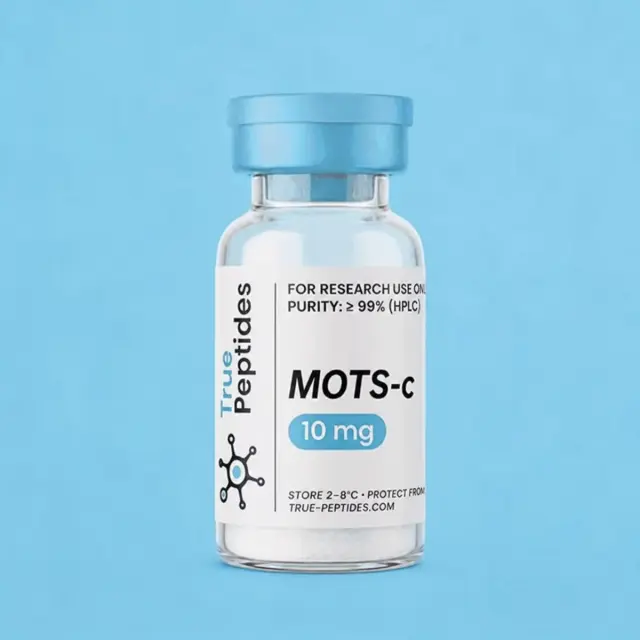
MOTS-c

Price range: $63.00 through $79.00
| CAS Number | 1627580-64-6 |
| Molecular Formula | C100H156N28O22S2 |
| Molecular Weight | 2174.5 g/mol |
| Amino Acid Sequence | MRWQEMGYIFYPRKLR |
| Purity | >99%(HPLC verified) |
| Form | Lyophilized powder |
| Available Sizes | 10mg, 20mg |
| Storage | Store at -20C (lyophilized) or 2-8C (reconstituted) |
MOTS-c: Benefits, Uses, Research, and What You Should Know
MOTS-c is a naturally occurring peptide that has attracted growing interest in scientific research involving metabolism, cellular energy, exercise, and healthy aging. Unlike conventional supplements, MOTS-c is an investigational peptide studied for its potential effects on metabolic pathways and cellular function.
As interest in peptide research continues to expand, many people are searching for information about MOTS-c benefits, uses, dosage, safety, and research. Understanding what is currently known—and what remains uncertain—is essential before considering this compound.
What Is MOTS-c?
MOTS-c is a small peptide encoded within mitochondrial DNA. Researchers have identified it as a mitochondrial-derived peptide, meaning it originates from genetic material associated with the mitochondria.
Mitochondria are structures inside cells that play a central role in producing energy. Because MOTS-c is connected to mitochondrial biology, scientists have investigated whether it may influence metabolic processes and cellular responses to physiological stress.
Research into MOTS-c remains an evolving field, and much of the evidence comes from laboratory and preclinical studies rather than large, long-term human clinical trials.
How Does MOTS-c Work?
Researchers are investigating MOTS-c because of its relationship with metabolic regulation and cellular signaling. Experimental research suggests that the peptide may interact with pathways involved in glucose metabolism, energy balance, and adaptation to metabolic stress.
MOTS-c has also been studied in connection with exercise-related cellular responses. Some research indicates that its activity may change in response to physiological conditions such as physical activity and metabolic stress.
However, mechanisms observed in laboratory models do not necessarily translate into established therapeutic effects in humans. More clinical research is needed to determine the significance of these findings.
Potential MOTS-c Benefits
Interest in MOTS-c benefits primarily comes from preclinical research examining metabolism and cellular health. Researchers have explored its possible relationship with glucose regulation, metabolic flexibility, mitochondrial function, and age-related biological processes.
Some experimental studies have produced interesting findings involving insulin sensitivity and metabolic regulation. Other research has examined whether MOTS-c could play a role in the body’s response to exercise and physiological stress.
These findings are scientifically promising but should not be interpreted as proof that MOTS-c can prevent, treat, or reverse a particular disease. Human evidence remains limited, and additional controlled clinical studies are needed.
MOTS-c and Metabolic Health
One of the most frequently discussed areas of MOTS-c research is metabolic health. Researchers are investigating whether the peptide influences pathways associated with glucose utilization and insulin signaling.
Metabolism is a complex process involving multiple organs, hormones, enzymes, and signaling pathways. A compound that affects one pathway in an experimental setting may not produce the same outcome in humans.
Consequently, MOTS-c should not be viewed as a proven replacement for established approaches to managing metabolic conditions, including appropriate nutrition, physical activity, and medical treatment.
MOTS-c and Exercise Research
MOTS-c has also received attention because of its connection to exercise biology. Research suggests that mitochondrial-derived peptides may participate in the body’s adaptive response to physical activity.
Scientists are interested in whether MOTS-c contributes to communication between mitochondria and other parts of the cell during periods of increased energy demand.
Although these findings may help researchers better understand exercise physiology, there is currently insufficient evidence to describe MOTS-c as a proven performance-enhancing treatment or exercise supplement.
MOTS-c Dosage and Administration
There is no universally established medical dosage of MOTS-c for general consumer use. Because it remains an investigational peptide, dosing protocols found online should not be treated as established medical guidelines.
The route of administration, concentration, frequency, and formulation can vary between experimental settings and products. Anyone considering an investigational peptide should consult a qualified healthcare professional rather than relying on online dosing recommendations.
Is MOTS-c Safe?
The long-term safety profile of MOTS-c in humans has not been fully established. Potential risks may depend on the formulation, dose, route of administration, product quality, and individual health circumstances.
Products sold online may also vary in purity and manufacturing standards. A product’s marketing claims do not establish its safety or effectiveness.
People with medical conditions or those taking prescription medications should obtain professional medical advice before considering an investigational compound.
MOTS-c is an intriguing mitochondrial-derived peptide that has become an important subject of research into metabolism, cellular signaling, exercise physiology, and healthy aging. Early experimental findings have generated interest, but research is still developing.
| QUANTITY | 10mg, 20mg |
|---|
Be the first to review “MOTS-c”
Related products

Peptide Catalog

Peptide Catalog
Peptide Catalog

Peptide Catalog

Peptide Catalog
Reviews
There are no reviews yet.