
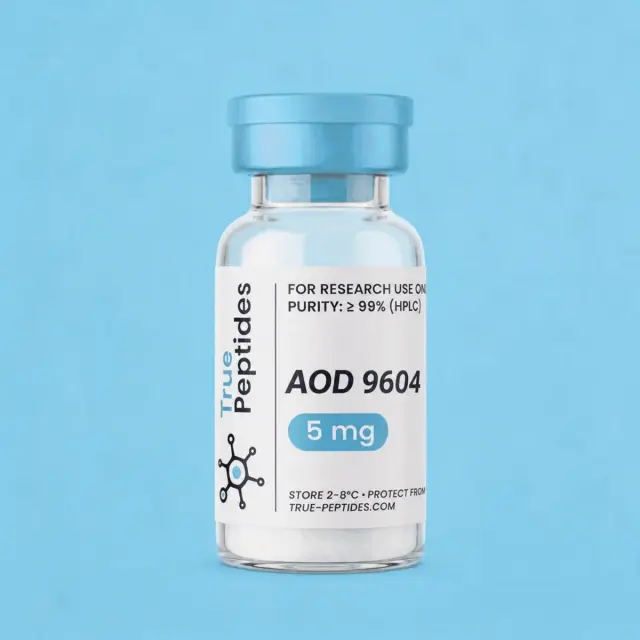
AOD 9604
$40.00
Quality Tested
3rd party verified
Support
Chat & e-mail
Fast Shipping
Priority same-day
About This Compound
Reconstitution Note
To reconstitute properly, add bacteriostatic water slowly along the wall of the vial. Gently swirl — do not shake. If crystallization occurs, allow the vial to reach room temperature and swirl gently to redissolve. Store reconstituted solution at 2-8°C.
Product Specifications
| CAS Number | 221231-10-3 |
| Molecular Formula | C78H123N23O23S2 |
| Molecular Weight | 1815.1 g/mol |
| Amino Acid Sequence | HGH (177-191) fragment: YLRIVQCRSVEGSCGF |
| Purity | >99%(HPLC verified) |
| Form | Lyophilized powder |
| Available Sizes | 5mg |
| Storage | Store at -20C (lyophilized) or 2-8C (reconstituted) |
| Category | Metabolic Research |
| Testing | Third-party lab tested (HPLC, Mass Spec) |
| COA | View Certificates of Analysis → |
AOD 9604 Peptide: Research, Potential Benefits, Safety, and the Science Behind This Fat-Loss Peptide
Introduction
The global interest in weight management, metabolic health, and advanced peptide research has increased significantly in recent years. In the USA, UK, and Europe, researchers and health enthusiasts continue exploring new approaches that may influence how the body processes fat and maintains a healthy metabolism. One peptide that has gained attention in the field of metabolic research is AOD 9604.
AOD 9604 is a synthetic peptide fragment derived from human growth hormone (HGH). It was developed to study the fat-metabolizing properties of growth hormone while attempting to avoid some of the broader effects associated with full growth hormone activity. Research has focused mainly on its possible role in fat metabolism, lipolysis, and obesity-related pathways.
Although AOD 9604 is widely discussed online as a “fat-burning peptide,” it is important to understand that it is an experimental compound and is not an approved treatment for weight loss in many major markets. Scientific studies continue to evaluate its effectiveness, safety, and potential applications.
What Is AOD 9604?
AOD 9604 is a modified peptide consisting of amino acids 176–191 from the C-terminal region of human growth hormone. Scientists designed this fragment because research suggested that specific parts of growth hormone may influence fat metabolism without producing all of the hormone’s traditional growth-related effects.
Unlike human growth hormone, AOD 9604 was developed specifically to investigate metabolic effects, particularly the breakdown of stored fat. Early laboratory studies explored how this peptide interacts with fat cells and metabolic pathways.
The peptide became popular in longevity and fitness communities because of interest in its potential relationship with body composition and weight management.
How Does AOD 9604 Work?
Researchers have investigated several possible mechanisms behind AOD 9604’s activity.
Supporting Fat Breakdown (Lipolysis)
One of the main areas of research surrounding AOD 9604 is lipolysis, the process where stored fat is broken down and released for energy use.
Experimental studies have suggested that AOD 9604 may influence pathways involved in fat metabolism, including mechanisms connected with beta-adrenergic signaling. Animal research has shown changes in fat metabolism and body weight, although human results require further investigation.
Influence on Fat Storage Pathways
Scientists have also explored whether AOD 9604 may affect lipogenesis, which is the formation and storage of new fat cells.
The goal behind developing AOD 9604 was to identify a compound that could potentially encourage fat utilization without directly stimulating growth-related pathways associated with HGH.
Potential Benefits of AOD 9604: What Research Shows
AOD 9604 is commonly researched in several areas:
1. Weight Management Research
The strongest interest in AOD 9604 comes from obesity and weight management research. Scientists have studied whether the peptide may help regulate fat metabolism and support reductions in body fat.
Some early clinical research reported modest weight changes compared with placebo groups, but later studies did not demonstrate sufficient effectiveness for continued pharmaceutical development.
This means current evidence does not confirm AOD 9604 as a proven weight-loss treatment.
2. Metabolic Health Research
Because fat metabolism is closely connected with overall metabolic function, researchers have explored whether AOD 9604 may have broader applications in understanding metabolic pathways.
Studies have examined areas such as lipid metabolism and how the body processes stored energy.
3. Body Composition Studies
Fitness and wellness communities often discuss AOD 9604 in relation to improving body composition. However, scientific evidence remains limited, and results may vary depending on individual factors such as diet, exercise, genetics, and overall health.
AOD 9604 and Growth Hormone: What Makes It Different?
AOD 9604 was designed as a fragment of growth hormone rather than a replacement for the complete hormone.
Researchers were interested in whether it could maintain certain fat-metabolism-related properties while reducing effects associated with full HGH activity, such as broader hormonal stimulation.
However, the relationship between AOD 9604 and human weight loss remains complex, and more high-quality clinical research is needed.
Is AOD 9604 Safe?
The long-term safety profile of AOD 9604 in humans is not fully established.
Because it is considered a research peptide rather than an approved mainstream medication, important questions remain regarding:
- Long-term health effects
- Appropriate medical applications
- Product quality and purity
- Possible immune reactions
- Interactions with existing health conditions
Anyone considering experimental peptides should consult a qualified healthcare professional and carefully evaluate scientific evidence before use.
AOD 9604 Availability and Regulation in the USA, UK, and Europe
Regulations surrounding research peptides vary between countries.
In the United States, United Kingdom, and European markets, AOD 9604 is generally not approved as a prescription weight-loss medication. Availability and legal requirements can differ depending on national regulations.
Consumers should be cautious of exaggerated marketing claims, especially products promoting guaranteed fat loss or rapid body transformation without strong clinical evidence.
The Future of AOD 9604 Research
As obesity and metabolic diseases continue to be major global health concerns, researchers are investigating new approaches to understanding fat biology and energy regulation.
AOD 9604 remains an interesting peptide because it represents an attempt to target specific metabolic pathways associated with fat breakdown.
Future clinical studies will be necessary to determine whether AOD 9604 has meaningful applications in medicine, weight management, or metabolic health.
Conclusion
AOD 9604 is a research peptide derived from a fragment of human growth hormone and has gained attention because of its potential connection to fat metabolism and weight management.
While laboratory and early studies have created interest, current evidence does not establish AOD 9604 as a proven fat-loss medication. More research is needed to understand its effectiveness, safety, and possible role in future metabolic therapies.
For individuals researching peptides, understanding the difference between scientific investigation and promotional claims is essential. AOD 9604 remains a promising area of study, but it should be viewed as an experimental compound rather than a guaranteed solution for weight loss.
Be the first to review “AOD 9604”
Related products

Peptide Catalog
Peptide Catalog
Peptide Catalog
Peptide Catalog

Reviews
There are no reviews yet.